
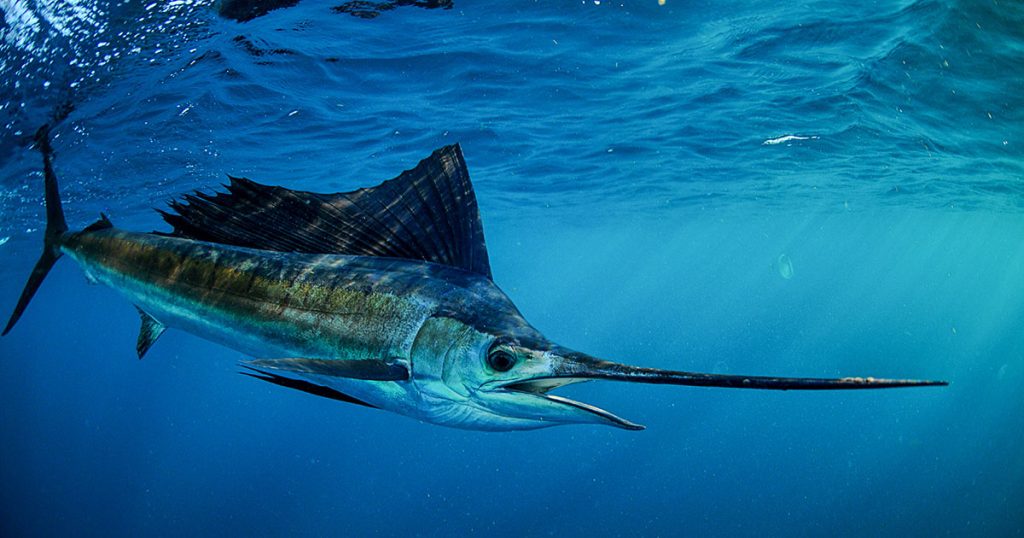
In this latest fish blog, we turn our attention to Florida, where the state fish is the sailfish (Istiophorus platypterus). Not only is the sailfish the state fish of Florida, but Stuart (where CSA Ocean Sciences’ corporate headquarters is located) is also known locally as the Sailfish Capital of the World. Images of the iconic fish are almost omnipresent around town, and it is prominently featured on the official seals of both Martin County and the City of Stuart.
The sailfish is the largest species we will cover as we go through the state saltwater fishes. They can reach up to 3 m in length, including their long bill, although they are relatively lightweight compared to some other large pelagic fish; at most, they weigh approximately 90 kg. Named for the long, sail-like dorsal fin on their back, which can be raised and lowered, the sailfish is easy to distinguish from other billfish like marlin or swordfish. The dorsal fin is accented with dark spotting over a vibrant blue coloration that extends across the upper half of the body. The tail is broad and strongly lunate (crescent-moon shaped), and the pelvic fins are long.
The sailfish is a highly migratory species, undertaking long migrations of thousands of kilometers across ocean basins. They occur throughout the Atlantic, but prefer warm tropical and subtropical waters. Unlike some of the other state saltwater fishes, the sailfish is typically found in deeper, offshore waters of a few hundred feet deep. During spawning season, however, they may move closer to shore.
A single female sailfish is capable of laying millions of eggs a year, although only a tiny fraction survive to adulthood because many organisms feed on their eggs and larvae. This reproductive strategy is known as predator swamping: by producing such a large number of eggs, predators can eat their fill while leaving some eggs and larvae to survive.
The sailfish grows rapidly. Their larvae initially eat tiny invertebrates such as copepods. When only about 5 mm long, the sailfish expands its diet to include other fish larvae. Within a year, they are as long as a human is tall, reaching a few feet.
The long bill that gives billfish, like the sailfish, their common name has intrigued ichthyologists for many years, leading to questions about its evolutionary purpose. Recent research suggests that the bill plays an important role in prey capture, where the sailfish uses it to injure fish as they swim through schools of prey, striking fish along their sides. Microscopic, hardened structures along the sailfish’s bill may further increase its effectiveness by injuring their prey enough that the sailfish can capture them.
The sailfish is also an important game fish. In Florida, interest in the species began in the Palm Beach area about a century ago. In 2025, over 140,000 fishing trips were made out of Florida alone in the hopes of catching one; by comparison, <5,000 trips were made out of Mississippi the same year. It is prized as a game fish for its dramatic look, size, and behavior, as it is known to jump far out of the water. Today, most fish are released after capture to swim another day.
References and Further Reading
Domenici, P., A.D.M. Wilson, R.H.J.M. Kurvers, S. Marras, J.E. Herbert-Read, J.F. Steffensen, S. Krause, P.E. Viblanc, P. Couillaud, and J. Krause. 2014. How sailfish use their bills to capture schooling prey. Proceedings of the Royal Society B: Biological Sciences 281(1784). doi:10.1098/rspb.2014.0444.
Florida Fish and Wildlife Conservation Commission. n.d. Sailfish. Available at: https://myfwc.com/wildlifehabitats/profiles/saltwater/billfish/sailfish/ (Accessed 6 July 2026).
Froese, R., and D. Pauly. 2026. FishBase. World Wide Web electronic publication. Available at: www.fishbase.org, version (02/2026).
Herbert-Read, J.E., P. Romanczuk, S. Krause, D. Strömbom, P. Couillaud, P. Domenici, R.H.J.M. Kurvers, S. Marras, J.F. Steffensen, A.D.M. Wilson, and J. Krause. 2016. Proto-cooperation: group hunting sailfish improve hunting success by alternating attacks on grouping prey. Proceedings of the Royal Society B: Biological Sciences 283(1842). doi:10.1098/rspb.2016.1671.
Hugi, A. 2022. Trophic ecology of sailfish larvae in the Gulf of Mexico: an analysis of diet, prey availability, prey quality, and influences on larval growth. University of Southern Mississippi, Hattiesburg, Mississippi, USA.
Jolley Jr., J.W. 1977. The biology and fishery of Atlantic sailfish, Istiophorus platypterus, from southeast Florida. NOAA Technical Report NMFS SSRF 675(2):82–87.
Lam, C.H., B. Galuardi, A. Mendillo, E. Chandler, and M.E. Lutcavage. 2016. Sailfish migrations connect productive coastal areas in the West Atlantic Ocean. Scientific Reports 6(1):38163. doi:10.1038/srep38163.
Mourato, B., F. Carvalho, F. Hazin, J. Pacheco, H. Hazin, P. Travassos, and A. Amorim. 2010. First observations of migratory movements and habitat preference of Atlantic sailfish, Istiophorus platypterus, in the southwestern Atlantic Ocean. Collective Volume of Scientific Papers ICCAT 65(5):1740–1747.
NOAA Fisheries. 2026. Recreational fisheries statistics queries. U.S. Department of Commerce. Available at: https://www.fisheries.noaa.gov/data-tools/recreational-fisheries-statistics-queries (Accessed 2 July 2026).
