
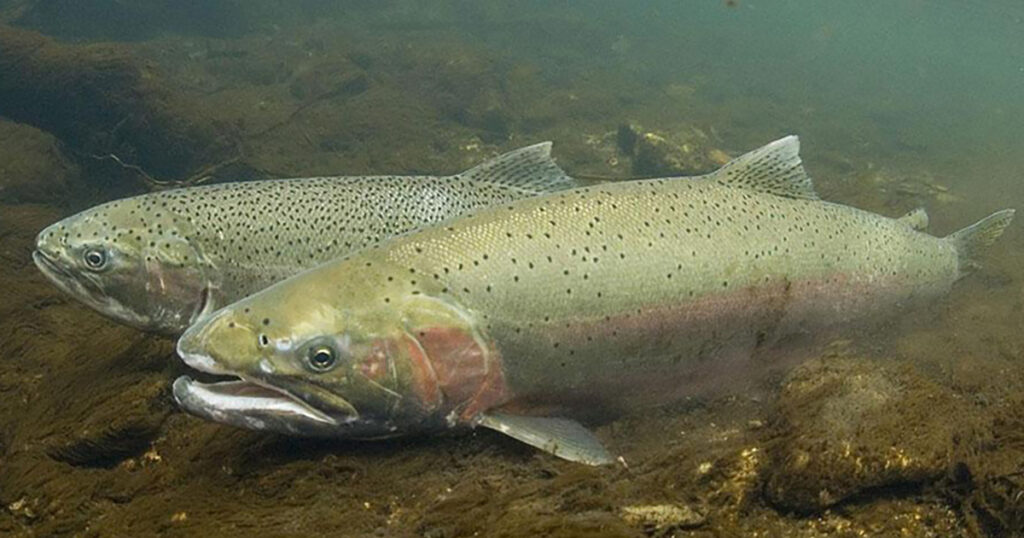
Steelhead trout are anadromous, meaning they migrate from the ocean to their natal (birthplace) rivers to spawn. If they follow the same lifestyle as salmon, why aren’t they called salmon? The name “trout” comes from the rainbow trout, which is actually the same species as the steelhead—O. mykiss—but rainbow trout remain in freshwater their entire lives. Trout, in general, are fish that do not venture into the ocean.
Like all salmon and trout, steelhead begin their lives as eggs laid in clear, cool water. Spawning occurs twice a year, with winter and summer spawning runs. Once the eggs hatch, the young fish—called alevins—remain mostly hidden beneath their large yolk sacs. As the yolk sac is absorbed, the fish grow and transition into the fry and parr stages, gradually looking more and more like adult fish. Between a few months and two years of age, young steelhead migrate downstream to the ocean; those that stay in freshwater are considered rainbow trout.
In freshwater, steelhead eat a variety of prey: algae, plankton, insects, other fish and their eggs, and even the occasional mouse unlucky enough to fall into the water. Once in the ocean, their diet expands to include squid, polychaetes, and crustaceans, and they can grow to an impressive 30 pounds.
As spawning time approaches, steelhead undergo several physical changes, developing a reddish coloration and a slightly hooked jaw. However, these changes are relatively subtle compared to the dramatic flair that many other salmon species are known for—the coloring is mainly along their midline and face, and only the bottom jaw curves into a hook.
Steelhead trout also stand out for another reason: they are often repeat spawners. While many Pacific salmon species, like the Chinook (king), die after a single exhausting spawning event, many steelhead can spawn for multiple years, before dying or being eaten by predators.
Steelhead are managed like most other Pacific Northwest salmon fisheries—through distinct population segments (DPSs). DPSs apply only to vertebrates and identify known populations that are biologically or geographically separated from other populations within the same species. Although this raises broader questions about species distinctions (a topic for a different blog), in salmon and trout the DPS designation usually refers to their natal river system. For example, Puget Sound steelhead originate from the Puget Sound watershed, while Snake River Basin steelhead come from the Snake River Basin.
Many DPSs of steelhead trout are considered federally Endangered or Threatened. They have lost much of their freshwater habitat, and they require clear, cool water with gravel for spawning and safe refuges for resting. Habitat degradation, warming waters, and dams that block access to spawning waters continue to pose serious challenges. Restoration work—ranging from dam removal or placement of in-stream structures to create underwater refuges—is ongoing across the region.
References and Further Reading:
Center, W. S. Steelhead. from https://wildsalmoncenter.org/salmon-species/steelhead/.
Light, J.T., 1985. Food and feeding of steelhead trout in the epipelagic waters of the North Pacific Ocean.
Merz, J.E., 2002. Seasonal feeding habits, growth, and movement of steelhead trout in the lower Mokelumne River, California. California Fish and Game, 88(3), pp.95-111.
NOAA (2025). Washington dam removal opens Lower Columbia River tributary for salmon and steelhead. Retrieved 11/18/2025. https://www.fisheries.noaa.gov/feature-story/washington-dam-removal-opens-lower-columbia-river-tributary-salmon-and-steelhead.
NOAA Fisheries. 2025. Steelhead. https://www.fisheries.noaa.gov/species/steelhead.
NOAA, USFWS. (1996). Policy Regarding the Recognition of Distinct Vertebrate Population Segments Under the Endangered Species Act. National Oceanic and Atmospheric Administration, Department of Commerce; U.S. Fish and Wildlife Service, Department of the Interior. 61 FR 4722: 96-2639: 4722-4725.
Olsen, D. 2022. The complicated tale of salmon and trout. Retrieved 11/18/2025. https://ocean.si.edu/ocean-life/fish/complicated-tale-salmon-and-trout.
Walford, L.A. 1937. Marine game fishes of the Pacific Coast from Alaska to the Equator. University of California Press, Berkeley. 205 pp.
Washington Department of Fish and Wildlife. Steelhead (Oncorhynchus mykiss). Retrieved 11/18/2025. https://wdfw.wa.gov/species-habitats/species/oncorhynchus-mykiss-steelhead#conservation.