
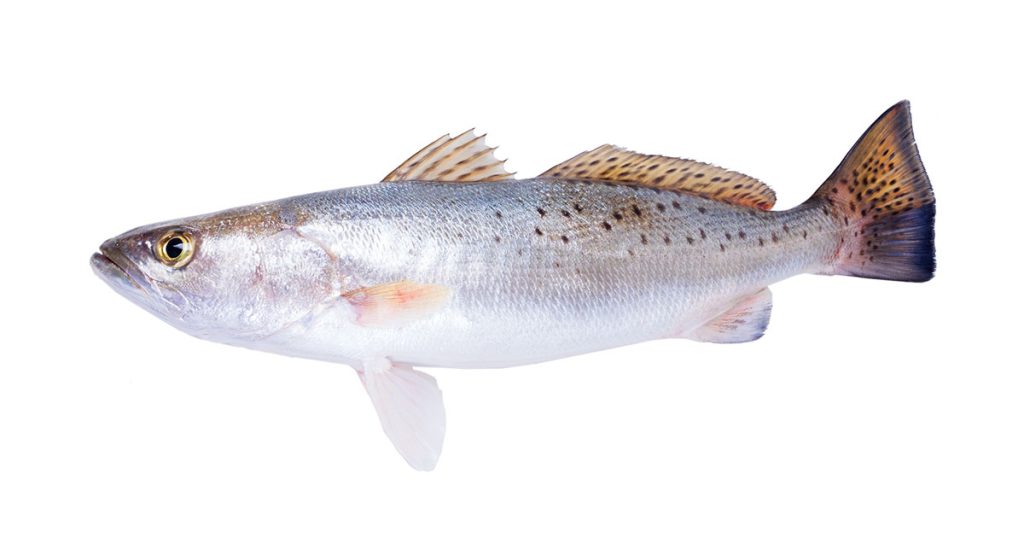
To continue our celebration of state saltwater fishes, we move on to the spotted seatrout (Cynoscion nebulosus), also known as spotted weakfish or speckled trout. Just like the last fish blog installment that focused on the red drum (Sciaenops ocellatus), the spotted seatrout is also a member of the drum, or Sciaenidae, family.
Spotted seatrout can be identified by the black spots scattered along the sides of their silvery gray bodies, large second dorsal fin, and caudal fin. This distinguishes them from the lookalike weakfish (C. regalis), which lacks spots on its fins. Spotted seatrout also have pointed, sharp teeth, and particularly large canines. They may be mistaken for salmon or trout because of similarities in head and body shape; however, their spotting patterns and teeth are distinctive.
Spotted seatrout are the official state saltwater fish of Louisiana (where it is referred to as spotted seatrout) and have a wide geographic range, occurring throughout the Gulf of Mexico and along the Atlantic coast as far north as New York, although they are more common in warmer waters. They support both recreational and commercial fishing and are considered a prized food fish.
Spotted seatrout spawn in bays and over seagrass and reach maturity within a few years. As adults, they are found in coastal, shallow waters, including estuaries, salt marshes, and rivers.
While spotted seatrout are caught and landed by both recreational and commercial fisheries throughout their range, they are most popular in the Gulf. A 2015 summary of recreational effort in the Gulf noted that about a third of all fishing trips targeted spotted seatrout. Spotted seatrout are generally caught close to shore, with almost all of the catch occurring in state waters. In 2025, approximately 3.5 million recreational fishing trips were taken in the Gulf, and well over 3 million trips were taken in the Atlantic, all in pursuit of spotted seatrout.
However, in many areas of the Gulf, spotted seatrout populations have been considered overfished, meaning stock biomass is low, with overfishing still occurring, meaning fishing mortality rates remain too high. A cold snap in 2021 in Texas additionally resulted in the mortality of an estimated 160,000 fish. Commercial landings were highest in 1973 and 1974, when over 8 million pounds were landed annually. Today, commercial landings are small, less than 1,000,000 pounds annually. As a result, a variety of management strategies have been implemented, including bag limits, slot limits, gear bans, and classification as a game fish. Efforts are ongoing throughout the Gulf to increase the size and health of the spotted seatrout stock.
References and Further Reading:
Coffill‑Rivera, M., J. Cope, J. Mareska, and S. Powers. 2025. 2025 stock assessment of spotted seatrout Cynoscion nebulosus in Alabama.
Eckert, C., E. Briell, and E. Getz. 2025. Insights into a renowned fishery: distinct spatial patterns, environmental predictors and species associations of trophy‑class spotted seatrout (Cynoscion nebulosus [Cuvier 1830]). Fishes 10:19.
Froese, R., and D. Pauly. 2026. FishBase. World Wide Web electronic publication. https://www.fishbase.org. Version 02/2026.
Louisiana Department of Wildlife and Fisheries. n.d. Hot topic: spotted seatrout. https://www.wlf.louisiana.gov/page/spotted-seatrout.
Louisiana State Legislature. 2001. Fishing: designates the spotted seatrout as the official state saltwater fish (HB 1692).
NC Department of Environmental Quality. n.d. Spotted seatrout. https://www.deq.nc.gov/about/divisions/marine-fisheries/public-information-and-education/species-profiles/spotted-seatrout-original.
NOAA Fisheries. 2016. Saltwater recreational fisheries in the Gulf of Mexico: a snapshot. NOAA Fisheries.
NOAA Fisheries. 2025. Fisheries One Stop Shop: landings. U.S. Department of Commerce. https://www.fisheries.noaa.gov/foss/f?p=215:200:4923449266473.
NOAA Fisheries. 2026. Recreational fisheries statistics queries. U.S. Department of Commerce. https://www.fisheries.noaa.gov/data-tools/recreational-fisheries-statistics-queries.
