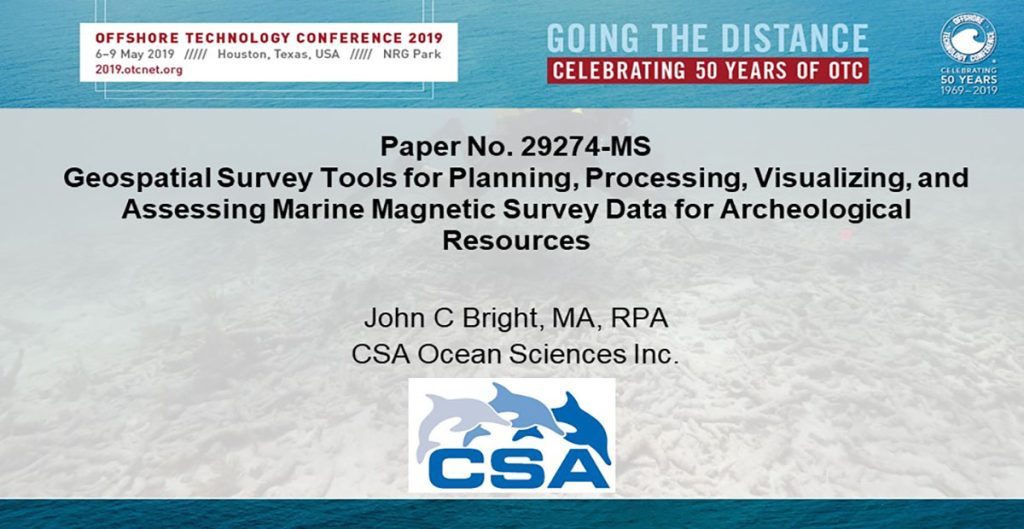
These tools, developed under a US Department of the Interior Inter-Agency Agreement between the Bureau of Ocean Energy Management (BOEM) and National Park Service (NPS), were tailored specifically for the needs of archaeological and historic property clearance surveys required by each agency. Application of these tools, however, can extend beyond prescribed regulatory surveys to aid archaeologists and geophysical surveyors conducting magnetometer surveys in numerous ways.
As demonstrated by Mr. Bright, the tools offer a versatile platform for data formatting, filtering, visualization, and post-survey assessment. Furthermore, the tools are semi-automated and substantially reduce data processing times, as well as execute repeatable and explicit geospatial processing functions, thus ensuring transparency and reliability.
“The Python scripts were developed with the intent to increase the efficiency of magnetic data processing, ensure the consistency and accuracy of resulting data products, and offer a quantitative assessment of marine magnetic datasets post-acquisition to more reliably report on the efficacy of a given magnetic survey,” John said.
Mr. Bright’s talk was delivered in the OTC Technical Program session “Advances in Technology for Identifying and Characterizing Submerged Archaeological Resources,” demonstrating the strong relationship between general geophysical survey methods and focused archaeological survey techniques.
