
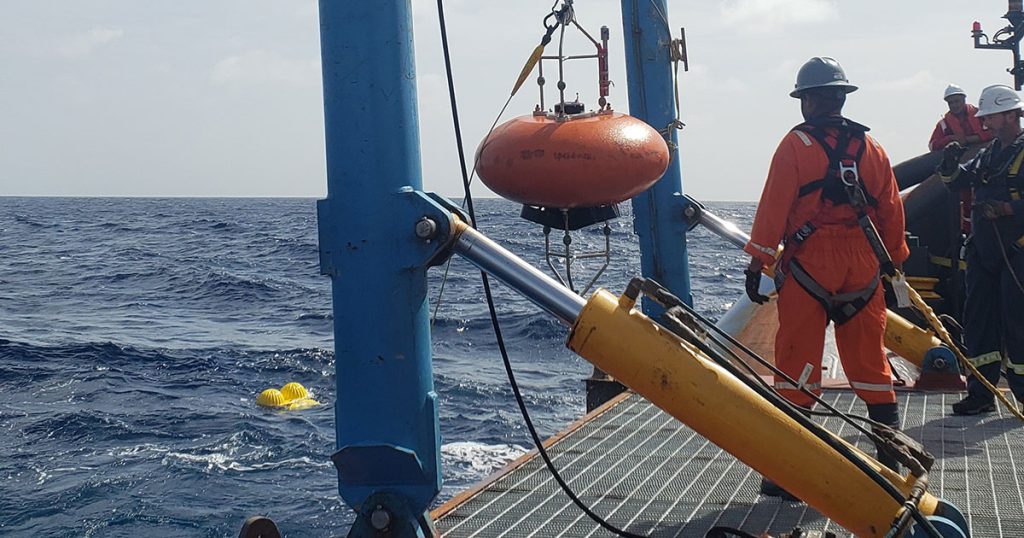
CSA Ocean Sciences Inc. (CSA) offers a range of data collection instruments to support client needs, including the Acoustic Doppler Current Profiler (ADCP). ADCPs have revolutionized how scientists measure metocean data, allowing them to collect data quickly, accurately, and with precision. Deployed on most vessels that CSA owns or charters, ADCPs allow scientists to measure water currents throughout the water column.
Using principles similar to echolocation employed by dolphins and bats, ADCPs emit sound waves into the water column. These signals reflect off particles in the water and bounce back to the ADCP, where they are analyzed to determine current velocity. The measurements are separated by where they come from in the water column, allowing currents to be characterized from near-surface waters to several meters below.
Scientists read these data to characterize current speed, tidal variability, and direction in real-time. For measurements over longer timeframes, ADCPs can be deployed on buoys or fixed installations to monitor temporal changes in current patterns. CSA is skilled at providing ADCP servicing, data download, and retrieval to best support project efficiency efforts.
Understanding currents is fundamental to interpreting movement in the ocean, from physical processes to biological systems. Currents transport sediment and can indicate the speed and extent to which marine debris or oil may travel in the event of a spill. Currents also influence the movement of nutrients and thus plankton, affecting organisms throughout the food web.
CSA, through its local subsidiary CSA Ocean Sciences (Trinidad) Ltd., has recently deployed ADCPs in the eastern Caribbean and off several South American countries, including Trinidad and Tobago, Barbados, and Suriname, in environments ranging from shallow waters 10–50 m deep to deep sea conditions of up to 2,000 m.
CSA has deployed ADCPs for durations ranging from just a few hours to several months. Off Barbados, ADCPs were deployed via mooring installations for a full year. These deployments have provided data to support environmental baseline surveys and environmental and social impact assessments. The resulting data enable our clients to make informed decisions in their day-to-day operations and reduce the risk of harm to assets, people, and the environment.
