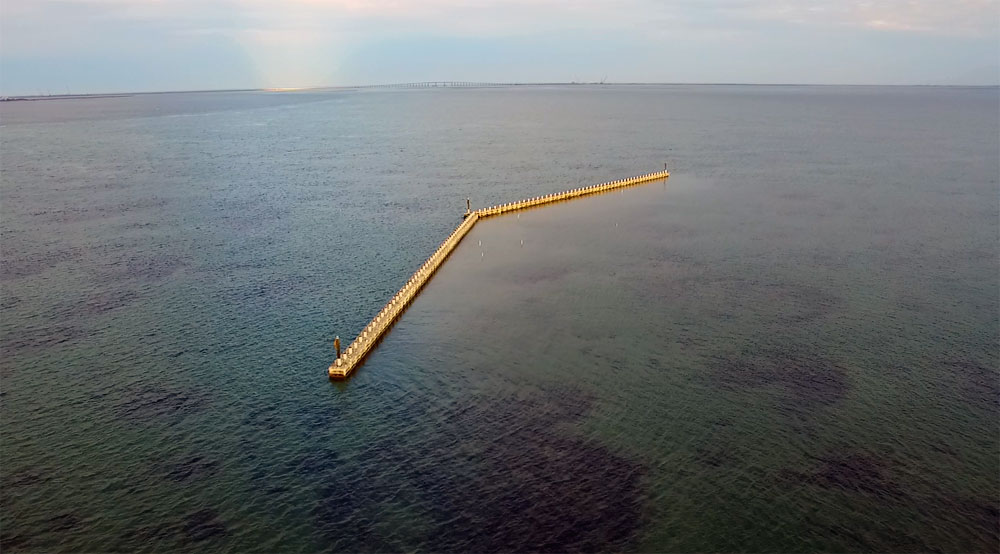
Approved by both federal and state regulatory agencies, this project builds on extensive research previously conducted by current CSA staff in order to exploit and manipulate the relationship between seagrass bed patchiness and waves and currents as an enhancement strategy. Using wave forecasting techniques to guide the size and location of the 500-ft long wave break, CSA and its team designed and installed the wave break among chronically patchy seagrass beds near the bridge. This wavebreak, which immediately began to alleviate disruption of seagrass beds from waves, is expected to allow the beds to coalesce, ultimately creating more complete and persistent seagrass cover of the seafloor.
Importantly, through this ecological engineering approach to seagrass enhancement, ecosystem services are provided even before any existing habitat is disrupted—a vital consideration in resource management where limited opportunities exist for enhancement. Added seagrass cover provides increased nursery and refuge areas for ecologically and economically important fish, shrimp, and crabs as well as increasing their abundance. This novel approach of creating an artificial shoreline in the open sound provides a new opportunity to both recover seagrass habitat loss associated with unavoidable project-related effects and create a structural basis for oyster colonization and fish utilization just as when applied along an actual shoreline. NCDOT and CSA will continue monitoring the effects of the wavebreak on seagrass expansion and its colonization by oysters and other marine life for the next five years.
