
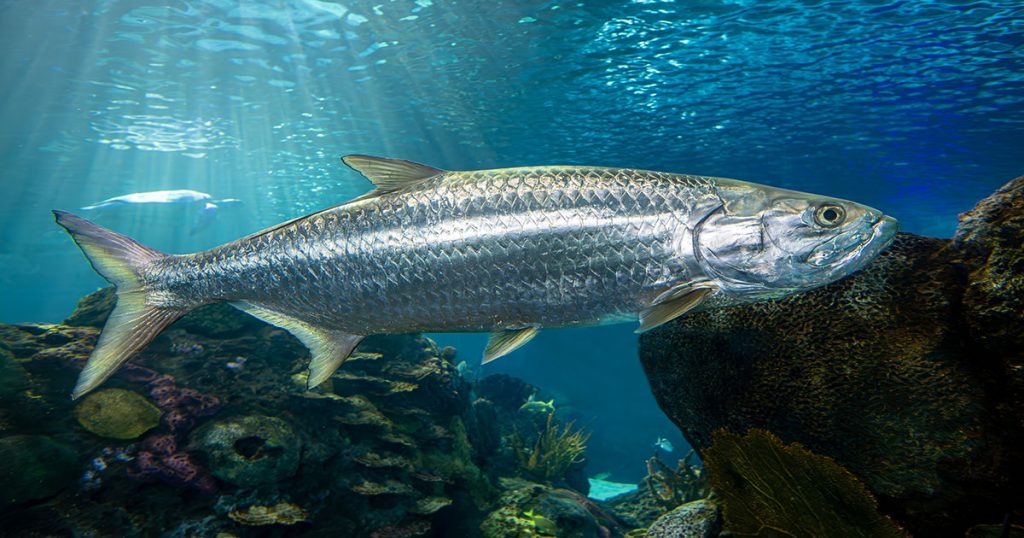
For the next installment in our fish blog series, we are moving over to Alabama, as there is no state saltwater fish for Mississippi. Alabama’s state fish is the Atlantic tarpon (Megalops atlanticus), also called tarpon or silver king.
Tarpon are part of an ancient superorder of fish called Elopomorpha, which diverged from other bony fish approximately 175 million years ago. The elopomorphs include fish like tarpon, bonefish, eels, halosaurs, and spiny eels. This group is characterized by having a unique larval life stage known as the leptocephalus stage.
The leptocephalus stage has an interesting history in the ichthyological world. Leptocephali were long thought to be an entirely different type of fish, representing a distinct order of fishes characterized by their long, translucent, leaf-like bodies and small heads. It was not until the 20th century that scientists realized that leptocephali are not a unique species, and are in fact the larval stage of the Elopomorpha. Stories like this are common in fish biology, as the larvae of many bony fish look dramatically different from their adult form.
Tarpon leptocephali are small, measuring only millimeters in length, although they already display one recognizable feature: the forked tail characteristic of adult tarpon. Adult tarpon have many distinguishing features, including large silver scales, a deeply forked tail, an elongated last ray on the dorsal fin, an upturned mouth, and a prominent operculum (gill cover). Fully grown, they can weigh around 300 pounds and be over 8 feet long. They feed on a variety of fish, crabs, and shrimp.
Tarpon are widespread along the Atlantic coasts of North and South America, throughout the Gulf, and along the coast of West Africa. They are most common in warm, tropical waters, but occasionally make their way farther north. A few years ago, a fisherman caught one off Cape Cod, Massachusetts.
Tarpon are a coastal species, found in bays, mangrove lagoons, and even freshwater environments. They migrate during late spring to early summer. Some undertake short local migrations, while others travel long distances crossing into the waters of several states.
Contrary to the general assumption that fish can only breathe underwater, some species can breathe air, including tarpon. Some studies consider them obligate air breathers, meaning they must breathe air at certain times, while others consider them facultative, capable of breathing air but not dependent on it. Ichthyologists are still working to understand what purpose air breathing serves in tarpon. Tarpon are often observed “gulping air” from the surface.
Tarpon are a well-known and coveted sportfish, famous for their large size and energetic fights. They are an important economic driver of recreational fishing in the southeastern United States. In 2025, over 250,000 individual recreational fishing trips targeted tarpon in the southern Atlantic, while over 600,000 trips in the Gulf focused on the species. These fisheries are largely catch-and-release, with most fish released after capture.
Tarpon are globally considered Vulnerable by the IUCN, although more data are needed to assess the status of the Gulf population. There is concern that tarpon released alive may still later die from the stress or exhaustion imposed by the fight. Other concerns include habitat degradation and declining water quality. There are several ongoing tarpon conservation efforts, including studies aimed at better understanding post-release mortality.
References and Further Reading
Adams, A., K. Guindon, A. Horodysky, T. MacDonald, R. McBride, J. Shenker, and R. Ward. 2019. Megalops atlanticus (errata version published 2020). The IUCN Red List of Threatened Species e.T191823A174796143.
Drymon, J., M. Jargowsky, M. Dance, M. Lovell, and C. Hightower. 2021. Documentation of Atlantic tarpon (Megalops atlanticus) space use and movement persistence in the northern Gulf of Mexico facilitated by angler advocates. Conservation Science and Practice 3:e331.
Froese, R., and D. Pauly. 2026. FishBase. World Wide Web electronic publication. https://www.fishbase.org. Version 02/2026.
Griffin, L., J. Brownscombe, A. Adams, R. Boucek, J. Finn, M. Heithaus, J. Rehage, S. Cooke, and A. Danylchuk. 2018. Keeping up with the silver king: using cooperative acoustic telemetry networks to quantify the movements of Atlantic tarpon (Megalops atlanticus) in coastal waters of the southeastern United States. Fisheries Research 205:65–76.
Griffin, L., G. Casselberry, E. Markowitz, J. Brownscombe, A. Adams, B. Horn, S. Cooke, and A. Danylchuk. 2023. Angler and guide perceptions provide insights into the status and threats of the Atlantic tarpon (Megalops atlanticus) fishery. Marine Policy 151:105569.
Kumar, S., M. Suleski, J. Craig, A. Kasprowicz, M. Sanderford, M. Li, G. Stecher, and S. Hedges. 2026. TimeTree 5: an expanded resource for species divergence times. Molecular Biology and Evolution. https://doi.org/10.1093/molbev/msac174.
Martin, L., A.M. Dichiera, and A.J. Esbaugh. 2025. The role of air breathing in exhaustive exercise recovery in Atlantic tarpon (Megalops atlanticus). Conservation Physiology 13(1):coaf089.
NOAA Fisheries. 2026. Recreational fisheries statistics queries. U.S. Department of Commerce. https://www.fisheries.noaa.gov/data-tools/recreational-fisheries-statistics-queries. Accessed 18 May 2026.
Pappas, L., and F. O’Laughlin. 2023. Rare catch! Fisherman hauls in massive tarpon off Cape Cod beach. Boston 25 News.
Sotte, S. 2016. Tarpons: biology, ecology, and fisheries. Wiley.
