
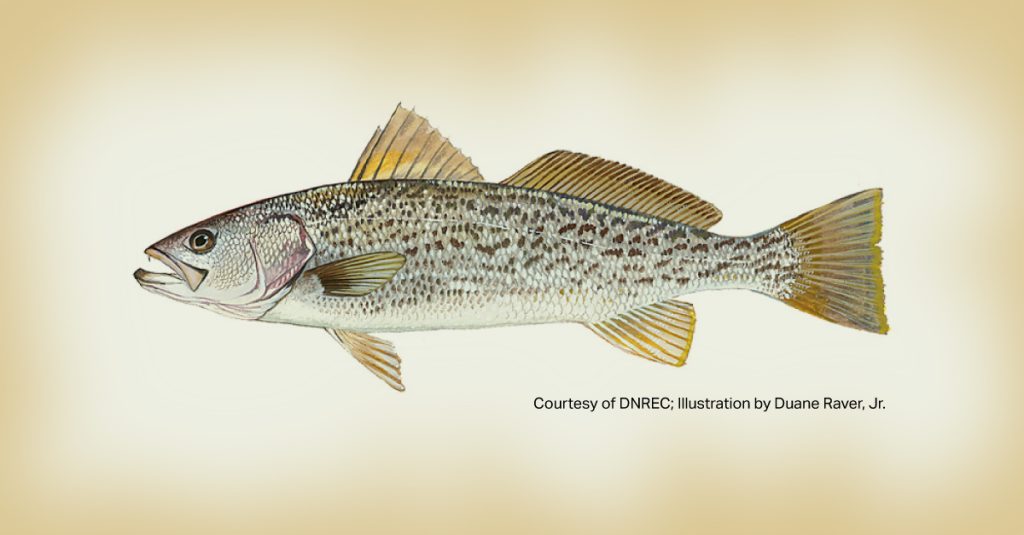
Continuing our way up the east coast, a trip accelerated by how many states chose striped bass (Morone saxatilis) as their state fish, we arrive at Delaware’s state fish, the weakfish (Cynoscion regalis). Weakfish are identified by their yellowish fins, gold-bronze spots, and prominent canine teeth (do not stick your fingers in their mouth!). Unlike spotted weakfish (Cynoscion nebulosus), covered in the May installment of our CSA Ocean Sciences (CSA) fish blog, their spots do not extend onto the fins. The common name “weakfish” comes from the thin membrane in the fish’s mouth, which can easily tear when hooked.
Weakfish are a member of the drum family (Sciaenidae). During mating season, they produce various sounds to attract mates: deep, “drum” like sounds, and higher-pitched, faster “chattering” sounds. Females and males both chatter, while only males will drum. Spawning season is from mid-May through July and takes place in inshore bays and estuaries.
Weakfish lay tiny eggs, just a couple millimeters in diameter. They hatch into larvae that are also incredibly small, under a few millimeters long. They spend the summer as larvae, growing steadily bigger. In the fall, the now-juvenile weakfish migrate towards the coast. Adults remain in estuaries or close to shore throughout their life, feeding on invertebrates and small fish. Adults grow to only a few pounds and reach at most 2 feet in length.
Weakfish range across the east coast from Florida up to Nova Scotia, and are concentrated in the mid-Atlantic. Weakfish used to be common, hence becoming Delaware’s state fish in 1981. In 1980, commercial fishermen landed nearly 36 million pounds of weakfish nationwide, including 1.8 million pounds attributed to Delaware. Similarly, in 1981, recreational fishermen landed over 19 million pounds, including ~440,000 pounds from Delaware (recreational data before 1981 are not available).
Shortly afterwards, the weakfish stock crashed, and most landings shifted to the recreational side. Recreational landings across the east coast peaked in 1987 at 20.5 million pounds. By 1990, commercial landings were 9.3 million pounds and recreational landings were 2.4 million pounds. Ten years later in 2000, commercial fishermen landed 5 million pounds, and recreational fishermen 8 million pounds. As of 2024, the most recent year with available data, commercial landings were down to <200,000 pounds, and recreational landings were ~600,000 pounds. Still, when anglers can find one, they are a popular food fish, known for their rich flavor. They are also excellent smoked.
The Atlantic States Marine Fisheries Commission (ASMFC), which oversees weakfish management, considers the stock as having been in a depleted state since 2003. Due to tight commercial and recreational regulations, overfishing is not happening, although weakfish are still suffering from high levels of natural mortality. Adults in particular are not surviving well, which is preventing stock recovery. Fisheries scientists are actively trying to understand why there are such high levels of mortality. One hypothesis is that an increase in predator populations, including other fish, dolphins, and birds, is contributing to weakfish mortality. However, this remains unconfirmed, and work is ongoing.
References and Further Reading
Atlantic States Marine Fisheries Commission (ASMFC). 2025. Weakfish. https://asmfc.org/species/weakfish/. Accessed 10 August 2026.
Connaughton, M.A., and M.H. Taylor. 1995. Seasonal and daily cycles in sound production associated with spawning in the weakfish, Cynoscion regalis. Environmental Biology of Fishes 42(3):233–240.
Delaware Department of Natural Resources and Environmental Control. n.d. Weakfish. https://fishspecies.dnrec.delaware.gov/FishSpecies.aspx?habitat=2&species=192. Accessed 10 August 2026.
Delaware Public Media. 2015. Where did all the weakfish go? Delaware Public Media. https://www.delawarepublic.org/science-health-tech/2015-11-20/where-did-all-the-weakfish-go.
National Oceanic and Atmospheric Administration (NOAA) Fisheries. 2025. Fisheries One Stop Shop: landings. NOAA Fisheries, U.S. Department of Commerce.
Olney, J.E. 1983. Eggs and early larvae of the bay anchovy, Anchoa mitchilli, and the weakfish, Cynoscion regalis, in lower Chesapeake Bay with notes on associated ichthyoplankton. Estuaries 6(1):20–35.
