
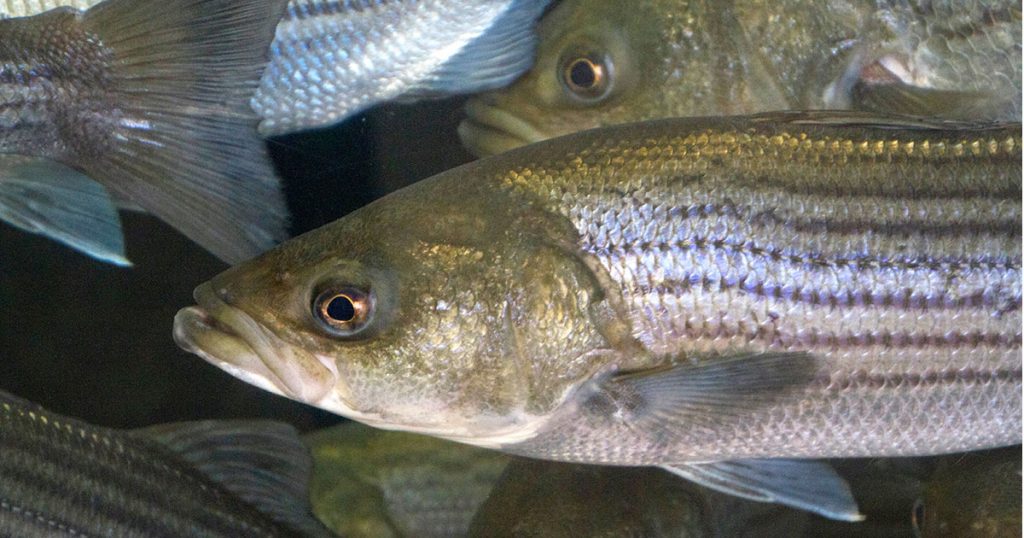
Next on the list for our state saltwater fishes is the striped bass (Morone saxatilis), a favorite of many anglers and so widespread that several states have adopted it as their state fish: South Carolina, Virginia, Maryland, New Jersey, New York, Rhode Island, and New Hampshire. Their range extends beyond these states, from Louisiana up into Canada. Despite such a broad range, most striped bass spawn in the Chesapeake Bay area.
Striped bass, often also called stripers or rockfish, are known for their size and striking looks. Striped bass can grow several feet long—up to 5 feet—though they are usually harvested at smaller sizes depending on the industry. They have long black stripes running along their sides, from the operculum (gill cover) to the base of their tail. These stripes are considered “unbroken”—they run along the same row of scales. If you ever see a striped bass at the grocery store with stripes that look “broken”, almost pixelated, that is a hybrid, a cross between a striped bass and a freshwater white bass, and a common aquacultured species.
Striped bass can be found both offshore and inland in fresh water, depending on the season. Like salmon, they are anadromous, spawning yearly in fresh waters. Spawning occurs in April and May, but big adults can be found far up rivers at other times of the year too, as some stay in fresh water year-round. Unlike salmon, adult striped bass can spawn several times, returning to freshwater annually. Young fish typically stay inland until they are about 10 years old, or 80 cm long.
Striped bass are best known, however, as a saltwater fish, living in coastal estuaries, bays, salt ponds, and out in the ocean. They are found in both nearshore and offshore environments. They are also long lived, maxing out at around 30 years old. If they survive the sensitive larval and juvenile stages, when many other fish and invertebrates prey on them, they become so large that they have few predators left.
Like many other fish, striped bass larvae start out eating plankton but quickly graduate to larger prey. Young striped bass often travel in big schools, and so are called “schoolies.” They have a diverse diet—smaller fish, insects, and crabs are all on the menu. As they get older and bigger, their diet shifts mainly to crabs, squid, and fish—anything they can catch.
Striped bass have long been popular in recreational and commercial fishing. The commercial fishery landed over 10 million pounds annually across the country in the late 1960s and into the 1970s. Shortly afterward, though, landings began to fall, and the fishery collapsed in the mid-1980s: in 1985, 1.2 million pounds were landed, and in 1986, that dropped to under 350,000 pounds. Extensive management work, known as stock rebuilding, including stocking, quotas, and size limits, helped the fishery recover, and in 2024 (the latest year of data available), 3.7 million pounds were landed nationwide. These numbers are still well below their peak because of a tight quota, as the stock is still considered overfished, meaning fewer fish are around than should be for a healthy population. Additionally, since 1999, recruitment—the number of young bass maturing into adults—has been low.
At the same time, the recreational catch has grown. In the 1980s (recreational data before this are not available), anglers caught less than 5 million striped bass a year across the country. This quickly grew to 40 million caught in 1998, peaking at 58 million in 2006. Due to declining recruitment numbers and subsequently tightening regulations (for example, a 28- to 31-inch slot limit in some states), the catch has fallen again, down to 13 million in 2025.
Led by the Atlantic States Marine Fisheries Commission (ASMFC), rigorous management and conservation work continues throughout the striped bass’s range to increase recruitment. Anglers looking to fish for striped bass should keep an eye out for the next stock assessment, expected to come out next year.
References and Further Reading
Atlantic States Marine Fisheries Commission. 2026. Atlantic Striped Bass. https://asmfc.org/species/atlantic-striped-bass/. Accessed 8/5/2026.
Chesapeake Bay Foundation. n.d. Striped Bass (Rockfish). https://www.cbf.org/nature/striped-bass-rockfish/. Accessed 8/6/2026.
NOAA Fisheries. 2026. Atlantic striped bass. https://www.fisheries.noaa.gov/species/atlantic-striped-bass. Accessed 8/5/2026.
Richards, R., and P. Rago. 1999. A case history of effective fishery management: Chesapeake Bay striped bass. North American Journal of Fisheries Management 19:356-376.
Secor, D., M. O’Brien, B. Gahagan, J. Watterson, and D. Fox. 2020. Differential migration in Chesapeake Bay striped bass. PLoS ONE 15(5):e0233103.
