
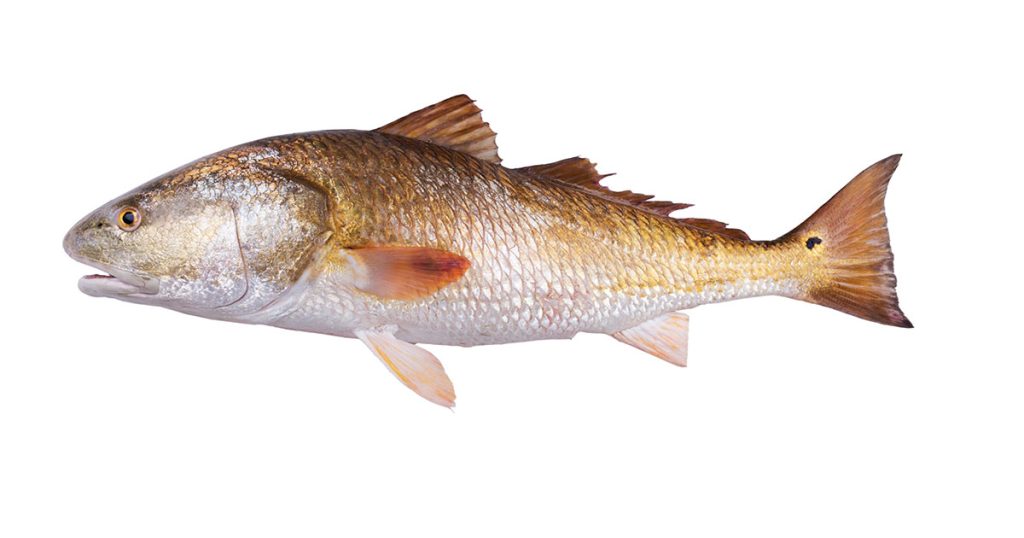
Now that we have finished covering the state marine fishes of the Pacific states, we are turning our attention towards the marine fishes of the southeastern states. The red drum (Sciaenops ocellatus) is the state fish of Texas, Georgia, and North Carolina, although its range extends much farther north, reaching as far as Massachusetts. In addition to inhabiting coastal marine environments, red drum are highly tolerant of varying salinities and can be found miles upriver in freshwater systems.
Red drum belong to the Sciaenidae, or drum, family. Members of this family are known for the characteristic sounds they produce, which sound like a low-frequency drumming. The drum sounds are made via contractions muscles associated with the swim bladder. Males produce these sound during spawning, when multiple individuals gather and form a “chorus.”
Although known as a “red” drum, individuals display a variety of muted colors. Common hues include near silver and gray, rusty red, brown, or black. They are typically darker on their dorsal, back, and sides. A defining feature is the presence of a distinct spot on the upper edge of the tail peduncle, or base of the tail. This spot is black with a lighter colored ring around it, a pattern that ichthyologists call “ocellated”.
Red drum are highly prolific, capable of laying well over 500,000 eggs in a single spawning season, with peak spawning in September and October. Spawning takes place in tidal inlets. Eggs are released into the water column and remain pelagic (floating in the water column). These eggs typically hatch within a day, hatching into larvae only a few millimeters long. The duration of this stage varies with water temperature and salinity, generally lasting from three to six weeks. During this time, larvae inhabit seagrass beds, which provide shelter and forage. As individuals grow to a few inches long and develop their fins, they transition to the juvenile stage. Juveniles are commonly found in estuarine environments and require several years to reach maturity. Upon reaching adulthood, red drum move into nearshore waters, typically a few miles offshore, where they feed on a variety of prey, including other fish, crabs, shrimp, and polychaetes (marine worms).
Red drum is a common food and game fish. Commercial harvest occurs primarily along the Atlantic coast from New Jersey to North Carolina, where 237,000 pounds were landed in 2024. Mississippi is the only Gulf state that permits commercial harvest with a landing of 33,000 pounds in 2024. Recreational fishing for red drum is more widespread, with nearly 8 million pounds caught across the species’ Atlantic range in 2024. This is in addition to the several million additional pounds landed by recreational fishers in Gulf states.
Despite this popularity, some populations are under pressure. The southern stock (South Carolina to Florida) is considered overfished, with overfishing currently occurring. This indicates that the stock is declining and is being harvested at levels that are not sustainable.
Aquaculture of red drum began in the Gulf states in the 1980s to supplement the declining wild stock. Shortly afterwards, red drum aquaculture expanded globally, even beyond the species’ native range. Today, China is a leading producer, accounting for the majority of global output, producing over 70,000 metric tons in 2018, compared to ~5,000 metric tons produced elsewhere.
In the United States, hatchery-raised fish are primarily released into the wild to enhance natural stocks, although some are sold for consumption. In contrast, international producers mainly export red drum as a food product to the US. Fish used for stock-enhancing are typically released as juveniles. Texas has released millions of red drum since its stocking program began in 1977.
In 2007, a presidential order prohibited the sale of red drum that had been caught from federal waters in response to declining stocks. Conservation and management efforts to protect the species continue today. Anglers in Georgia are advocating for stricter regulations, Florida has reduced the allowable catch, and South Carolina recently introduced more restrictive regulations. Among the Gulf states, only Mississippi permits a commercial harvest, and even there the quota is small, limited to 60,000 pounds annually.
A recent study from the Texas Parks and Wildlife Department indicates that past conservation efforts, including stocking programs and regulatory changes, have contributed to the Gulf stock rebound, as evidenced by larger fish, higher survival rates, and increased movement from estuarine to offshore habitats. In North Carolina, where the stock is considered healthy, biologists are using tagging programs to track red drum movements, sharing these data via a publicly-accessible platform.
References and Further Reading
Anderson, J., M. Fisher, R. Weizelman and N. Beeken (2023). Rapid changes in age structure, mortality, and escapement accompanied stock recovery of the estuarine Red Drum population of Texas. Marine and Coastal Fisheries: Dynamics, Management, and Ecosystem Science 14(e10247).
ASFMC. 2025. Red Drum. https://asmfc.org/species/red-drum/. Accessed 17 March. 2026.
Davis, J.T. 1990. Red drum: biology and life history. Southern Regional Aquaculture Center, Texas Agricultural Extension Service. 2 pp. https://www.lsuagcenter.com/~/media/system/1/b/1/7/1b17ca7a6e6dc2e0461d07781629f243/life_history_redfish.pdf.
CoastalReview.org. 2026. More red drum to be added to satellite tracking platform. https://coastalreview.org/2026/03/more-red-drum-to-be-added-to-satellite-tracking-platform/. Accessed 17 March. 2026.
FAO Fisheries and Aquaculture. 2026. Sciaenops ocellatus. Cultured Aquatic Species Information Programme. Text by Cynthia K. Faulk, A. In: Fisheries and Aquaculture. Updated 2006-11-06. https://www.fao.org/fishery/en/culturedspecies/sciaenops_ocellatus/en. Accessed 17 March. 2026.
Gulf States Marine Fisheries Commission. 2023. Management profile for Gulf of Mexico Red Drum. Pub Number 317.1. https://www.gsmfc.org/publications/GSMFC%20Number%20317.1.pdf. 241 pp.
https://www.fao.org/fishery/en/culturedspecies/sciaenops_ocellatus/en
Lowerre‐Barbieri, S.K., Barbieri, L.R., Flanders, J.R., Woodward, A.G., Cotton, C.F., and Knowlton, M.K., 2008. Use of passive acoustics to determine red drum spawning in Georgia waters. Transactions of the American Fisheries Society, 137(2), pp.562-575.
Magtoto, J. 2025. Red drum conservation targets receive criticism from Georgia anglers. Savannah Morning News. https://www.savannahnow.com/story/news/environment/2025/11/11/the-asfmc-responds-to-the-redfish-decline/87062135007/. Accessed 17 March. 2026.
NOAA Fisheries. 2025. Landings Data: Release 3.16.13.1. https://www.fisheries.noaa.gov/foss/f?p=215:200:5156010394558 Accessed 17 March 2026.
South Carolina General Assembly. 2026. Bill 961 (Session 126, 2025–2026). https://www.scstatehouse.gov/sess126_2025-2026/bills/961.htm.
Texas Parks and Wildlife Department. n.d. Red drum (Sciaenops ocellatus). https://tpwd.texas.gov/huntwild/wild/species/reddrum/. Accessed 17 March 2026.
The Outdoor Wire. 2026. Fisheries managers to seek input on red drum regulation change at town halls. https://www.theoutdoorwire.com/releases/2026/02/fisheries-managers-to-seek-input-on-red-drum-regulation-change-at-town-halls/. Accessed 17 March 2026.
Looking for more fish blogs? Visit: https://csaocean.com/news/blog/