
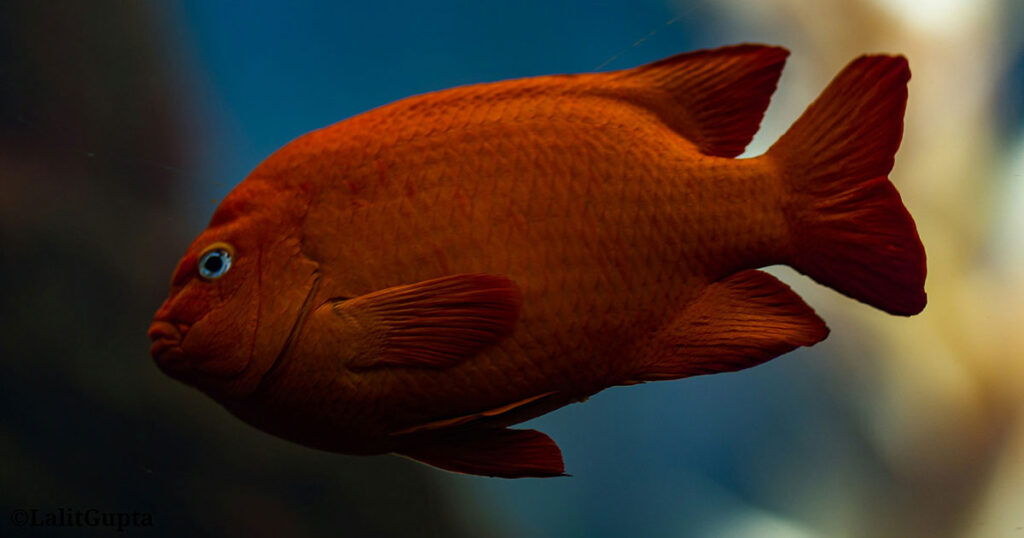
Looking like a puffed-up goldfish with beady blue eyes and a heart-shaped tail fin, the garibaldi lives among the kelp forest, where it feeds on a varied diet. Favorites include polychaete worms, anemones, bryozoans, and sponges, although the majority of its diet is red algae. Garibaldi are also known to eat eggs, including, at times, their own. They may eat eggs as a strategy to reduce competition, increasing the likelihood that their offspring survive rather than those of another garibaldi. In turn, garibaldi are eaten by a variety of predators, including other fish such as sharks and bass, as well as sea lions and bald eagles.
Nests are carefully built and maintained by males. A male clears a nest area along the reef, removing everything except red algae, which is eaten until only a red algae carpet remains. The male then attracts females to lay eggs through swimming displays and by grinding his teeth in his throat, which makes a “thumping” sound.
After the female lays her eggs, the male chases her away preventing her from eating any eggs that are not her own, and so the male can attract more females. A single nest may contain eggs from as any as 20 females. The territorial male closely guards the nest, aggressively defending it from intruders ranging from other fish to human divers by charging, biting, and producing warning sounds to dissuade anyone from coming near.
Orange when first laid, the eggs quickly turn gray. Within a few weeks they hatch into little larvae that sometimes drift away to an area far beyond where they hatched. Garibaldi larvae can settle more than 25 miles (40 km) from their hatch site. While all this is happening, the adult garibaldi often begins nesting again.
As the larvae develop into juveniles, they begin to show hints of the adult color. Young garibaldi are typically a muted orange in color with dots of bright blue all over their bodies—especially on their face and along portions of the fins. As adults, garibaldi can reach lengths of 1 ft (30 cm) and may live for decades; some individuals have been recorded to be over 50 years old.
Garibaldis once brightened many personal aquariums and fishing catches. Their striking appearance made them popular, too popular—leading to prohibitions on collecting and fishing that have been in place for several decades to help the species thrive. Today, garibaldi can be seen throughout their native range, but their range could shift as the ocean warms.
There is also some concern that garibaldi could be disturbed by nearby boat noise, given that they use sound to attract mates and ward off intruders. Fortunately, recent work suggests that they do not significantly change their behavior in response to ambient boat noise; however, additional research is needed to confirm these findings and fully understand the interactions between garibaldi and anthropogenic (human-created) noise.
References and Further Reading:
Aquarium of the Pacific. 2025. Marine Species Report Card. Accessed 11/19/2025.
Cook GS, Parnell PE, and Levin LA. 2014. Population connectivity shifts at high frequency within an open-coast marine protected area network. PLoS ONE, 9: e103654.
Froese R and Pauly D. 2025. FishBase.
Fuentes Calderon BE. 2023. Spatial and habitat variation in diet composition and associated life history patterns of garibaldi (Hypsypops rubicundus) in the southern California bight. California State Polytechnic University, Pomona.
Jones RC. 2024. Evaluating the impacts of acoustic masking on the Garibaldi, Hypsypops rubicundus. California State University, Northridge.
Monterey Bay Aquarium. Garibaldi: Hypsypops rubicundus. Accessed 11/19/2025. https://www.montereybayaquarium.org/animals/animals-a-to-z/garibaldi.
National Park Service. 2018. Garibaldi. Accessed 11/19/2025. https://www.nps.gov/chis/learn/nature/garibaldi.htm.
Sikkel PA. 1993. Reproductive ecology and endocrinology of the Garibaldi damselfish, Hypsypops rubicundus (Pomacentridae). Oregon State University.
World Wide Web electronic publication. www.fishbase.org, version (04/2025).