
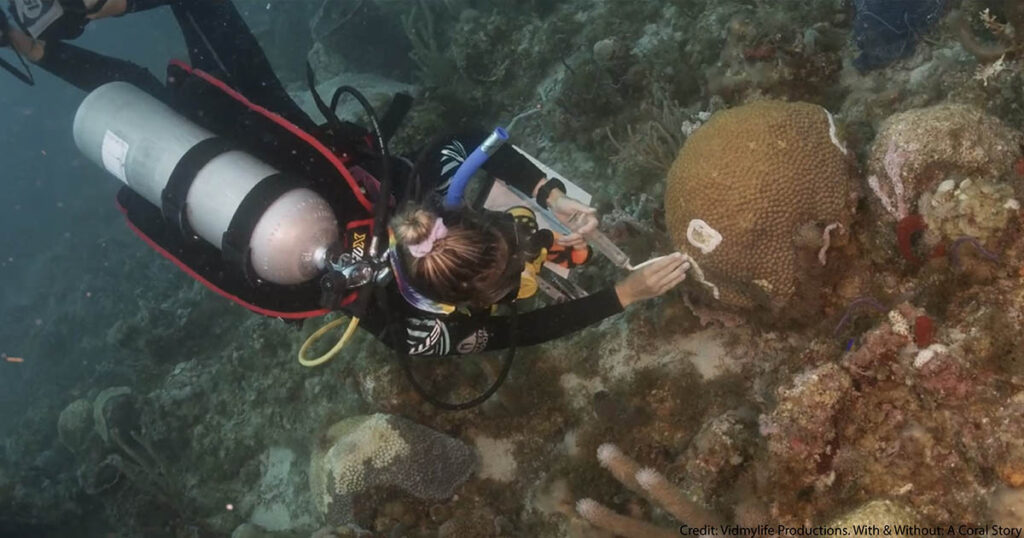
CSA scientist Amanda Zummo, along with her research colleagues, recently published new findings on an innovative coral disease intervention strategy aimed at combating stony coral tissue loss disease (SCTLD). SCTLD has caused widespread mortality across Caribbean reefs, threatening long-lived, reef-building species such as Montastraea cavernosa. The study evaluates the effectiveness of one-time, in situ antibiotic treatments applied at the scale of entire reef tracts, offering a pragmatic response in regions where SCTLD has become endemic.
Drawing on more than five years of intervention data from southeast Florida, the research demonstrated that a single antibiotic treatment can significantly prolong coral survival. At a single follow up visit at 41 months post-treatment, 94% of treated M. cavernosa colonies remained alive, with tissue loss substantially lower than levels documented for untreated populations. These results suggest that even without repeated monitoring or retreatment, such broad-scale disease intervention can meaningfully slow disease progression, preserve living coral tissue, and reduce long-term restoration burdens.
The findings underscore the growing importance of coral disease intervention as a proactive management tool alongside traditional restoration methods such as outplanting and coral propagation. By preserving existing coral colonies and their genetic diversity, disease intervention can save years of restoration effort and associated resources. As SCTLD continues to spread throughout the Caribbean, this research provides managers and practitioners with science-based evidence that targeted, in situ treatments should remain a critical part of the coral reef restoration toolbox.
The paper is freely available at this link: https://link.springer.com/article/10.1007/s00338-025-02797-5
